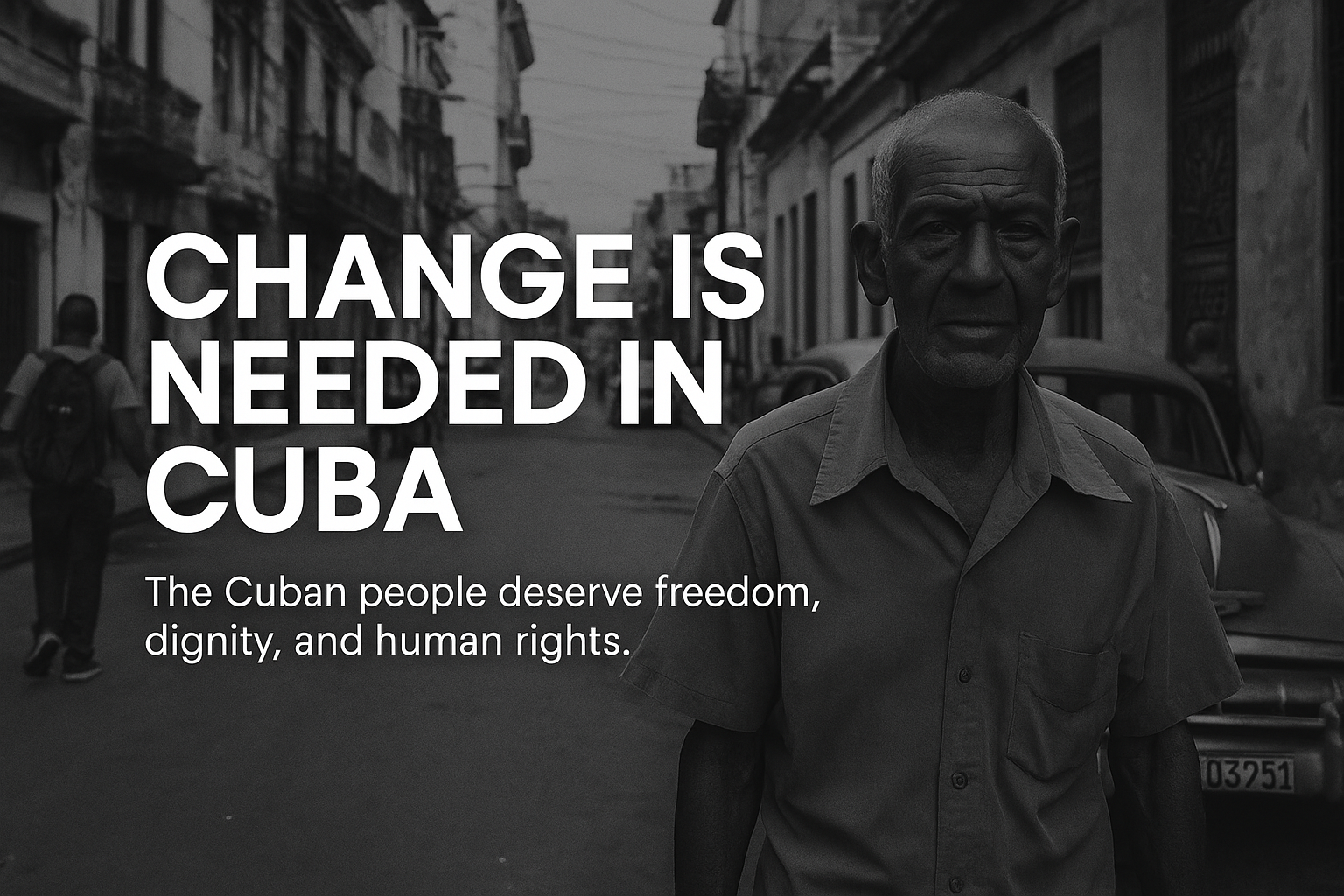
For more than six decades, the Cuban people have endured a system that has claimed legitimacy in the name of revolution, yet has systematically violated their most fundamental rights. Behind the rhetoric of anti-imperialism and social justice lies a state apparatus built on surveillance, censorship, and control. What was once a political project has become an authoritarian regime, disconnected from the reality of its people and incapable of offering solutions to a deepening crisis.
Today, Cuba is facing a breaking point.
The country is mired in a multidimensional crisis. Basic services such as healthcare, electricity, food distribution, and education have collapsed. Prolonged blackouts leave families in the dark for hours each day. Supermarket shelves remain empty. Hospitals lack basic medicine, and patients are often required to bring their own supplies to be treated. Inflation has skyrocketed, and wages are nowhere near sufficient to meet daily needs.
More than 400,000 Cubans have left the country in just the past two years—the largest migratory wave in the island’s modern history. Most are young, educated, and desperate for opportunity, dignity, and freedom. These are not isolated cases of discontent. This is a population in exodus, fleeing not war but a government that has closed all pathways to individual and collective growth.
The Cost of Repression
Rather than listen to its citizens, the Cuban government has responded to growing demands for change with brutal repression. Peaceful protests, like those seen during the historic 11 July 2021 uprising, have been met with mass arrests, forced disappearances, and long prison sentences—including for minors. Journalists are harassed. Artists are banned. Civil society leaders are forced into exile, regulated, or imprisoned without due process.
Cuba currently holds over a thousand political prisoners—an astonishing number for a country with a population of just over 11 million. The state apparatus not only punishes dissent but actively criminalizes it. There is no space for independent political participation, freedom of association, or a free press. Even outside its borders, Cuban activists face transnational repression, intimidation of their families, and surveillance abroad.
Why Change Is Not Just Necessary—It Is Inevitable
The Cuban regime no longer has the support of its own people. The myth of the revolution has eroded, and a new generation is rising—connected, informed, and unafraid. Across neighborhoods, digital platforms, and the diaspora, Cubans are imagining and demanding a different country: one where rights are respected, voices are heard, and leadership is accountable to the people.
The path forward must involve a peaceful, citizen-led transition to democracy. This includes the release of all political prisoners, constitutional reform, free and fair multiparty elections, and the reestablishment of independent institutions. It means placing the Cuban people—not ideology—at the center of national life.
The Role of the International Community
It is no longer acceptable for the world to look away. The normalization of diplomatic relations should not come at the cost of silence in the face of repression. International actors must apply pressure for democratic reform, offer protection to those at risk, and support Cuban civil society both within the island and in exile. Governments, institutions, and human rights organizations must treat Cuba with the same standard they apply elsewhere.
The Cuban people are not asking for foreign intervention—they are asking for solidarity, visibility, and moral consistency. They are doing the work. They are taking the risks. They need allies.
A New Generation Is Ready
Organizations like the Foundation NewGeneration are helping build the foundations of this change. Through civic education, leadership training, and support for activists and refugees, we are investing in the future of a democratic Cuba—one rooted in dignity, human rights, and opportunity for all.
History teaches us that authoritarian regimes do not last forever. What sustains them is silence, fear, and complicity. But Cuba is waking up. A civic awakening is underway.
The time for change is not tomorrow. It is now. And it begins with courage, solidarity, and action.
